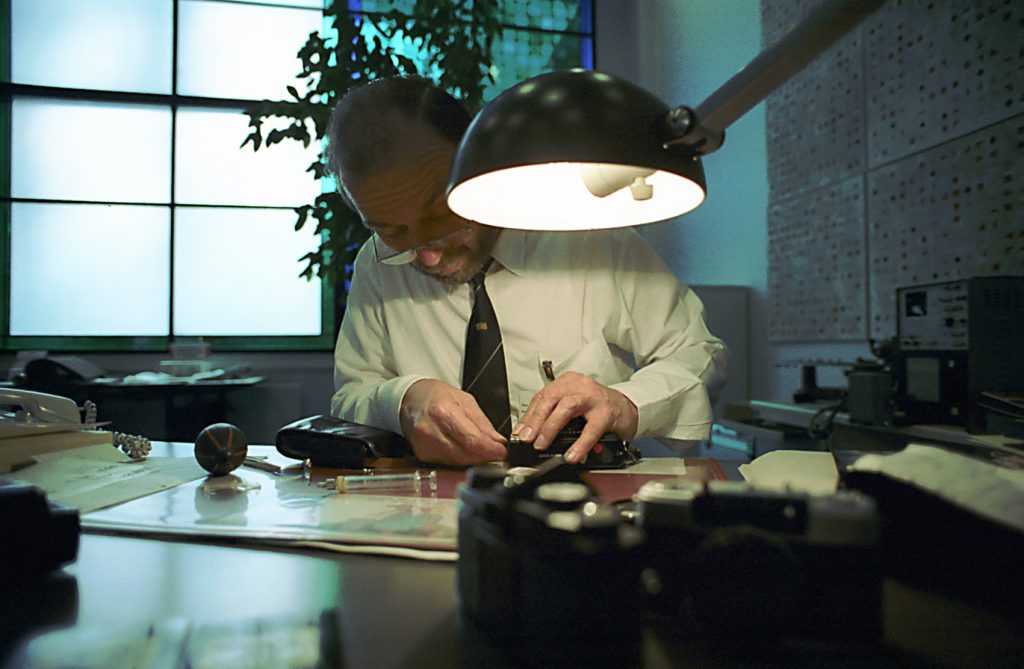
Frank Timmann has been repairing analog Olympus cameras for over 50 years – first as a service technician for the manufacturer, then as an independent OM doctor.
Click, clack, whir – the mechanical sounds of analog cameras have given way to the quiet beeping of autofocus and mostly electronic shutter sounds. Of course, digital photography offers amateurs and professionals enormous photographic freedom. Despite this progress, many people are still enthusiastic about the precision-engineered ancestors of modern cameras. Almost 25 years after my last analog SLR, I feel the same way. Looking for an easy way to get back into traditional photography, a local dealer recommends Olympus compact cameras. Since functional models are hard to find on the second-hand market, he refers me to Frank Timmann. The so-called OM-Doktor repairs, refurbishes, and sells analog cameras from the Japanese manufacturer.

“Yes, I know him well,” replies the Hamburg native when I mention the name of the store in Düsseldorf. Frank Timmann is quickly in his element. He has been repairing old, used cameras in his home workshop since 1996. Exclusively Olympus cameras – compact models as well as SLR models from the OM and PEN series. Previously, the trained precision mechanic had worked for almost 30 years as a service technician for the Japanese camera manufacturer. “I know every component by its first name,” he says, instilling confidence in his expertise and recommending two cameras to me: the automatic Trip 35 is inexpensive and easy to use. The Olympus 35 RD can be operated completely manually. I decide on the former. Except for four distance ranges, there are no noteworthy setting options on the fully automatic camera, so analog photography here is limited to the haptic and acoustic experience. The film is advanced via a thumb wheel, and the shutter release clicks as you would expect. At the end, the film roll has to be rewound manually.
Returning to the analog world
Even though I have taken the camera with me on every trip since then, I still have to remind myself to use it at the beginning. That’s because I still have my digital camera equipment at my fingertips (perhaps too often). So there are definitely situations in which I revisit a place to take an analog picture of a particular scene. Another lesson I’ve learned is how to choose my subjects. I quickly discarded my original idea of taking exactly one analog picture every day, as a routine, so to speak. More and more often, while taking digital photos, I find myself thinking about which shots I would also like to capture on film. For me, perhaps the best part of the analog process is the anticipation of seeing the developed images. After all, depending on how much I use it, it takes weeks for the film to fill up and then several more days for the lab to develop it. The finished images are either not as good as I had hoped or surprisingly beautiful. In any case, they evoke memories that I stylishly organize in a photo album.
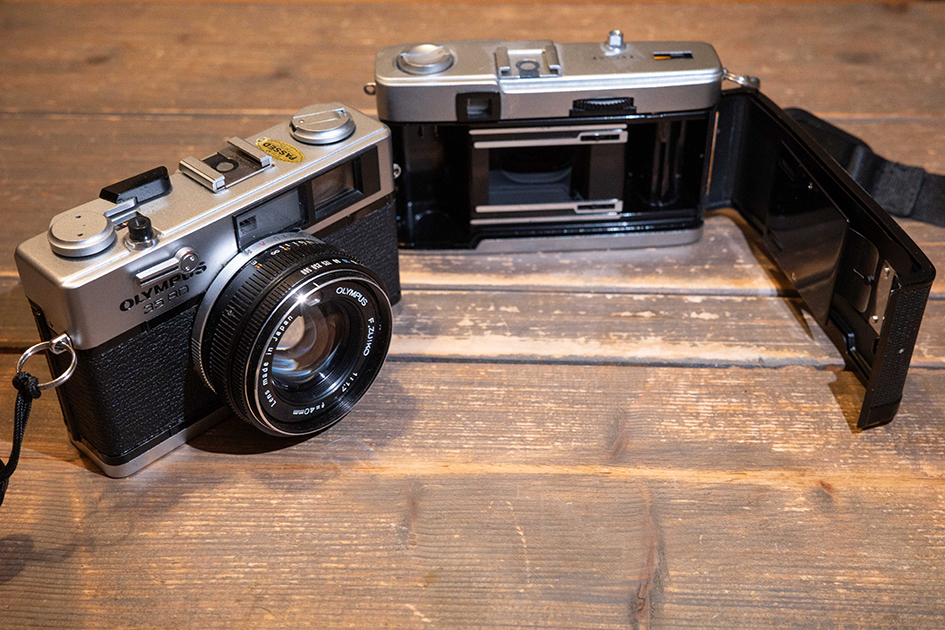
Two years later, I want to devote a little more time to this side project and turn to the OM-Doktor again. After all, there is also the Olympus 35 RD with manual operation and better light intensity. Since I happen to be traveling to Denmark for work, I make an appointment with him on my way back to take a look at this gem. “I have three of them here right now. I’ll get the nicest one ready for you,” he says, delighted by my interest. The visit gives me the opportunity to learn more about him and his work.
Personnel number 11
Frank Timmann was one of the first employees to start working at Olympus’s European headquarters in 1967, which was still very small at the time. His trainer was none other than Yoshihisa Maitani, the chief designer who developed the cameras of that era. The OM system (Olympus Maitani), introduced in 1972, was also the result of the Japanese engineer’s inventive spirit. Over the years, Frank Timmann passed on his technical knowledge and experience in training courses: “This allowed me to get to know many photo dealers throughout Germany.” He also supported photographers in all technical matters. “I was never an artist, but I was able to explain to artists how the camera works.”
In the course of restructuring at Olympus in the mid-1990s, Frank Timmann suggested adding another person to the service team. The division manager in charge was against it: “There’s no need to exceed customer expectations.” This statement was so contrary to the professional ethics of the passionate service technician that he immediately decided to leave Olympus. After a short career break, which he spent with his family in the Philippines (his wife’s home country), a Cologne-based photo dealer inquired about his whereabouts. “I assured him that I had left a thoroughly capable service department at Olympus,” recalls Frank Timmann. Now he had to reorient himself. The dealer had a better idea: “Get yourself a business license. I’ll be your first customer.”
The birth of the OM-Doktor
This and other good contacts in the trade gave Frank Timmann the opportunity to start his own business. From then on, he repaired cameras for Olympus customers from all over Germany – with the same dedication and customer focus as he had shown at his former employer. Shortly afterwards, he earned his “doctorate”: when he first started out on his own, Frank Timmann had a side job. “At the Christmas party there, a colleague asked me what I was always tinkering with lon the cameras like a surgeon.” And so the name was born.

Even at the age of 83, the OM-Doktor has no intention of giving up his practice. Repairing Olympus cameras and breathing new life into them is more than just a job he knows inside out. It is a calling he found through Yoshihisa Maitani. “Customers have a problem. They bring us their camera. And then we come in to solve the problem,” Frank Timmann echoes his words. This service philosophy still fulfills him: “Sending out a fully functional camera is the best part of my job.”